


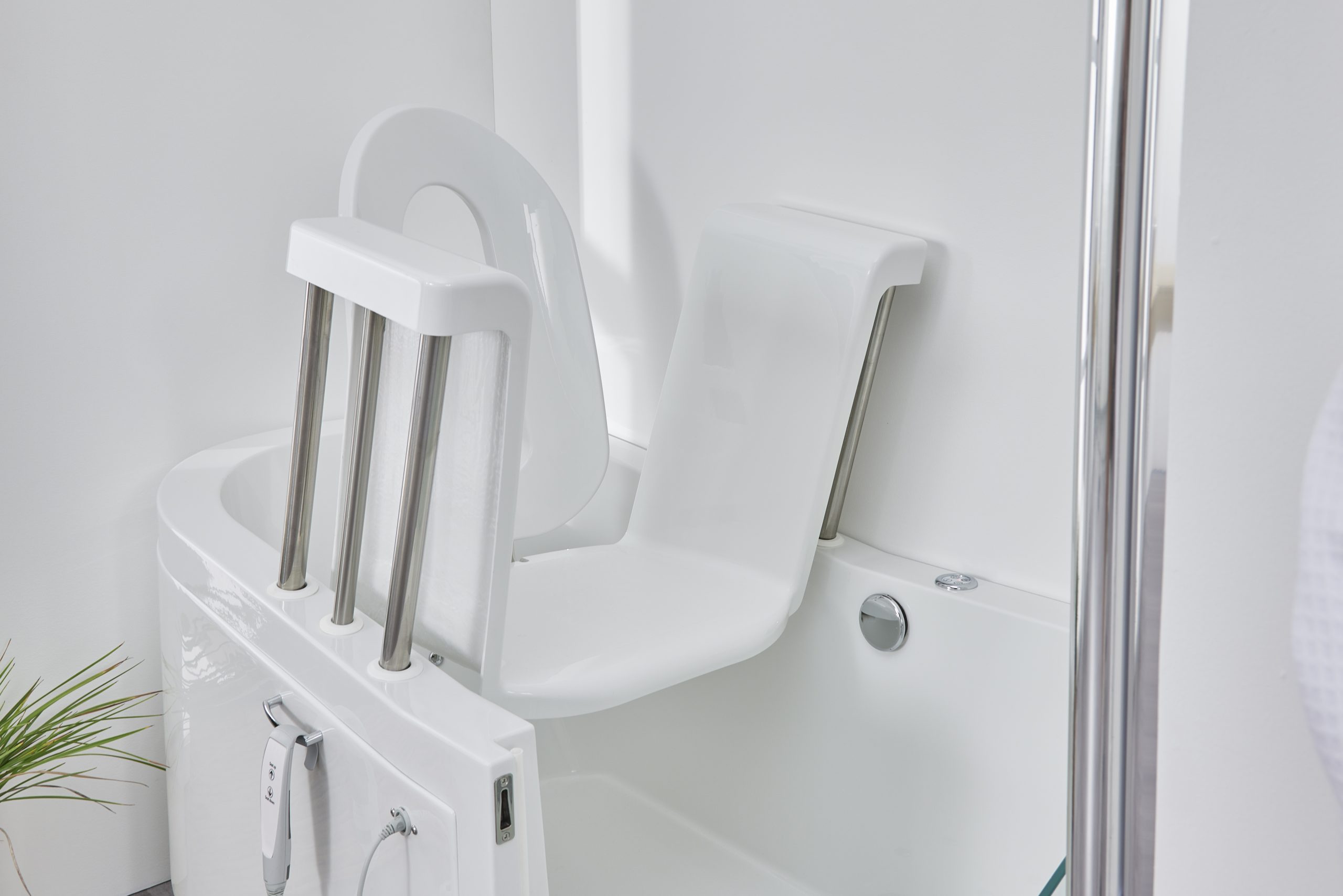
Power-Assisted Walk-In Baths: What They Are and Who Benefits Most
Walk-in baths have made safe, comfortable bathing possible for many people with mobility limitations. But for some individuals, even a standard walk-in bath presents a challenge — particularly when lowering into the bath water or rising back up requires strength or balance that is no longer reliably there.
A power-assisted walk-in bath addresses this directly. This guide explains what it is, how it works, who benefits most from it, and what to look for if you are considering one.
What Is a Power-Assisted Walk-In Bath?
A power-assisted walk-in bath is a walk-in bath fitted with a motorised, electrically powered seat. Rather than lowering yourself manually into the bath and using your own strength to rise again, the seat does the work for you — raising and lowering you into the water at the touch of a button.
The basic principle is the same as any walk-in bath: you step through a low-threshold side door, sit on the integrated seat, close and seal the door, and the bath fills. The difference is that with a power-assisted model, a simple hand control manages the seat height — no physical effort is needed to reach the bathing position or return from it.
How Does It Work?
The powered seat is operated via a waterproof hand control, typically with straightforward up and down buttons. Once you are seated with the bath door sealed, you press the control to lower the seat to a comfortable bathing depth. The bath fills as normal around you.
When you are ready to get out, you press the control to raise the seat back up to the entry position before the bath fully drains. Once at the correct height, the door can be opened and you step out safely. The movement is smooth and gradual — there is no jerking or sudden change in position.
The controls are designed to be manageable even with limited hand strength or reduced dexterity. Most models use clearly labelled, large-format buttons rather than anything requiring precision or fine motor skill.
Who Benefits Most from a Power-Assisted Walk-In Bath?
Power-assisted baths are the right choice for people whose mobility is beyond what a standard walk-in bath can comfortably accommodate. The groups who benefit most include:
- People with very limited lower body strength. If rising from a seated position is no longer possible without significant effort or assistance, the powered seat removes this requirement entirely.
- Those living with multiple sclerosis (MS). MS causes unpredictable muscle weakness, fatigue, and spasticity that can vary significantly from day to day. A power-assisted bath accommodates that variability and provides a safe bathing option regardless of how the individual is feeling on a given day.
- People with Parkinson’s disease. Parkinson’s affects movement control, coordination, and muscle rigidity. The powered seat removes the need to control a lowering or rising movement — something that is particularly difficult for those with the tremor and stiffness associated with Parkinson’s.
- Stroke survivors with significant weakness. For those left with substantial one-sided weakness or paralysis following a stroke, a power-assisted bath may be the safer option where a standard walk-in bath would still demand too much physical effort.
- Those requiring carer assistance. Where a carer is involved in the bathing process, a powered seat significantly reduces the physical demand on the carer — minimising the risk of injury to either party during transfers and movement.
- Anyone who has found a standard walk-in bath insufficient. If you already own a walk-in bath and are struggling with the process of getting in and out, a power-assisted model may be the upgrade that restores safe, comfortable bathing.
Power-Assisted vs Standard Walk-In Bath: Key Differences
The core difference is the seat mechanism. A standard walk-in bath has a fixed seat — you sit on it and manage your own movement into and out of the water using your own strength. A power-assisted bath takes that physical requirement away entirely.
Power-assisted models are typically slightly larger to accommodate the motorised mechanism, and they require a power supply to be available in the bathroom. In every other respect — the warm water immersion experience, the low-threshold door entry, the watertight seal — the two types are broadly similar.
The key question when deciding between the two is simply whether you need the motorised seat. If a standard walk-in bath still provides you with a safe and comfortable bathing experience, it is likely the better starting point. If not, a power-assisted model is worth exploring.
What to Look For When Choosing One
If a power-assisted walk-in bath is the right choice for you, the following factors are worth comparing between different models:
- Weight capacity. The seat’s rated weight limit should comfortably exceed the user’s weight. This is a non-negotiable safety specification.
- Ease of the hand control. The control mechanism should be simple enough to operate with limited hand strength or reduced dexterity. Large, clearly labelled buttons are preferable to anything that requires precision.
- Smoothness and speed of movement. The seat should raise and lower gradually and smoothly, without any jerking or sudden movement. Ask to see this demonstrated before committing.
- Safety cut-off. A well-engineered power-assisted bath should include a mechanism that halts seat movement automatically if any unexpected resistance is detected.
- Hydrotherapy option. Many power-assisted baths are available with built-in hydrotherapy jets. For conditions such as MS, Parkinson’s, arthritis, or stroke recovery, warm-water jet therapy can provide meaningful relief alongside the safety benefits.
- Warranty on the motor and mechanism. The powered components need to be covered by a solid warranty, and the company supplying the bath should have a clear aftercare process for any issues with the mechanism.
Installation and What to Expect
Installing a power-assisted walk-in bath follows the same process as a standard walk-in bath, with the addition of a suitable electrical connection to the bath location. Our team handles all of this, including any electrical work, as part of the installation.
Before we leave, we provide a full introduction to the bath and its controls so that you are completely confident using it independently. We remain available for any questions or aftercare needs after the work is complete.
As with all our installations, we begin with a free home survey where we assess your bathroom, understand your requirements, and provide a no-obligation design and quote before any work begins.
Ready to Take the Next Step?
If you are considering a new bathing solution, our team at Assisted Living Ltd is here to help. We offer a free home survey and 3D bathroom design with no obligation. Call us on 0800 980 6890 or contact us online to arrange a visit at a time that suits you.